
How to Hold a Colored Pencil Right for Easy Coloring is a question many people overlook until their hand starts to ache or their colors refuse to blend smoothly. Most of us assume coloring is effortless: you pick up a pencil and begin. But the way you hold that pencil quietly shapes everything, from how pigment lays on paper to how long you can color comfortably. A small shift in grip can mean the difference between stiff, streaky fills and soft, professional-looking layers.
Why your grip matters more than you think
Most people approach coloring the same way: grab a pencil, start filling the space, move on to the next section. It feels natural after all, we’ve been holding pencils since childhood.
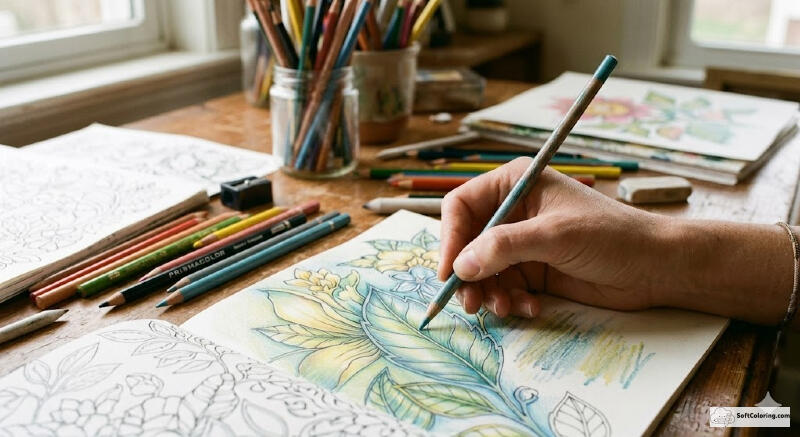
But here’s the truth most coloring guides overlook: how you hold your colored pencil directly affects how your art looks and how your body feels.
Grip isn’t just about comfort. It determines:
- How smoothly color goes onto the paper
- How well layers blend together
- How much control you have over details
- How long you can color before your hand aches
If you’ve ever struggled with streaky fills, uneven pressure, or hand fatigue after just one page, your grip may be the missing piece.
Let’s rethink it, not as a small technical detail, but as the foundation of easy, enjoyable coloring.
Understanding the Right Way to Hold Your Pencil
Here’s the real secret: there isn’t one perfect grip.
Instead, skilled colorists adapt their grip depending on what they’re trying to achieve. Think of it as switching gears rather than following one rigid rule.
Two core grips will dramatically improve your results.
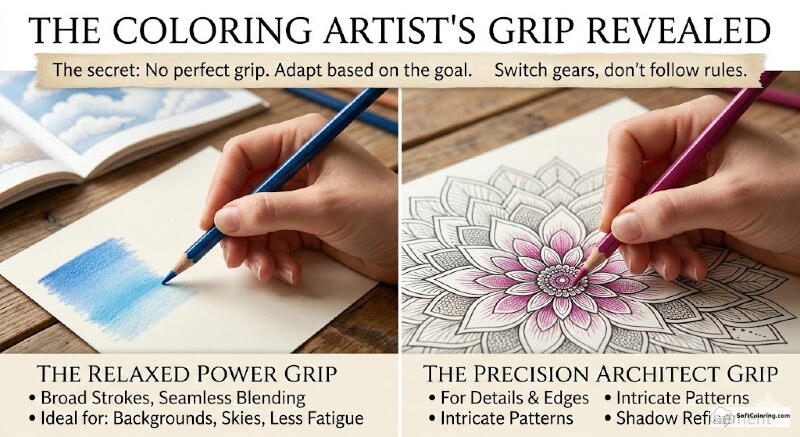
The Relaxed Power Grip for Broad Strokes & Seamless Blending
Instead of holding the pencil close to the tip, slide your fingers further back, almost as if you’re holding a paintbrush. Let your fingers stay soft. Allow your arm and shoulder to move, not just your wrist.
The result is surprisingly powerful.
Because you’re farther from the tip, you naturally reduce pressure. Color goes down more evenly. Large areas feel smoother. Blending becomes easier because you’re layering gently rather than pressing pigment into the paper.
This grip is ideal for:
- Backgrounds
- Large shapes
- Base layers
- Skies, skin tones, soft gradients
You’ll also notice less fatigue. Since your whole arm supports the movement, your wrist isn’t doing all the work.
The Precision Architect Grip for Details and Edges
When working on intricate patterns or sharp outlines, move your fingers closer to the pencil tip. Unlike a tense writing grip, however, the hold remains relaxed.
This grip provides greater control for fine lines and subtle shading transitions. It is ideal for tight corners, small shapes, highlights, and shadow refinement. The movement comes primarily from the fingers and wrist, allowing accuracy without excessive pressure.
The key difference is intention. You are guiding the pencil, not forcing it.
Simple Habits That Improve Your Coloring Experience
Grip matters most, but it doesn’t work alone.
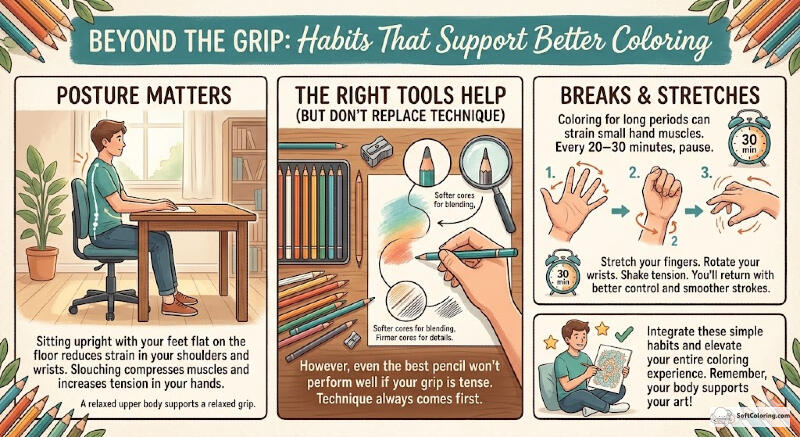
Posture Matters
Sitting upright with your feet flat on the floor reduces strain in your shoulders and wrists. Slouching compresses muscles and increases tension in your hands.
A relaxed upper body supports a relaxed grip.
The Right Tools Help (But Don’t Replace Technique)
Higher-quality colored pencils with softer cores blend more easily, while firmer cores are excellent for details. However, even the best pencil won’t perform well if your grip is tense.
Technique always comes first.
Breaks & Stretches
Coloring for long periods can strain small hand muscles. Every 20–30 minutes, pause.
Stretch your fingers. Rotate your wrists. Shake out tension.
You’ll return with better control and smoother strokes.
Common Coloring Grip Mistakes
After learning what the right technique looks like, it’s just as important to recognize the habits that may quietly undermine your progress. Many coloring frustrations don’t come from a lack of talent, they come from subtle grip patterns we repeat without noticing:
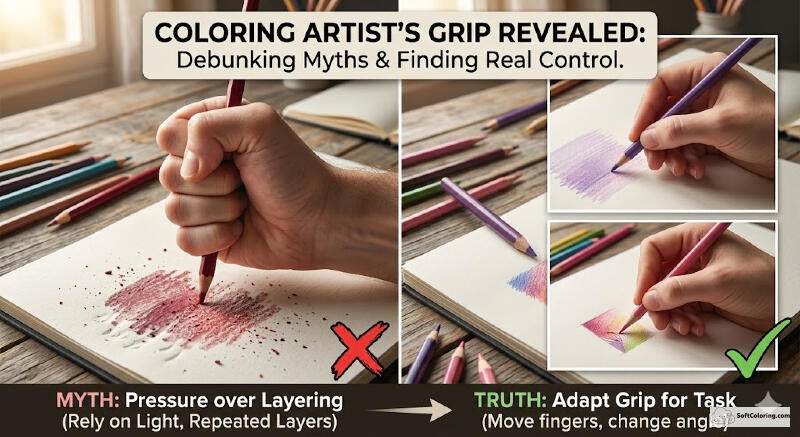
Gripping the pencil too tightly and relying on pressure instead of layering
Pressing hard may seem like a shortcut to bold color, but it actually reduces control and makes blending harder. Heavy pressure flattens the paper’s texture, creates streaks, and tires your hand quickly. Strong color should come from light, repeated layers—not force.
Holding it so loosely that control and precision are lost
While relaxation is important, a grip that’s too slack makes strokes unstable. The pencil can wobble, slip outside lines, and produce uneven shading. The goal is relaxed but steady control.
Using the same rigid grip you use for writing, without adapting for shading or blending
Writing relies on small, tight finger movements. Coloring often requires broader motion, softer pressure changes, and flexible angles. Sticking strictly to a writing grip limits movement and makes smooth blending more difficult.
Practice Makes Progress: How to Re-Train Your Grip
Changing the way you hold a pencil takes awareness and repetition. But small adjustments can quickly feel natural.
Awareness Is Key
During your next coloring session, you can feel free to pause and notice your grip. Are you squeezing? Are your shoulders tense?
Simply noticing tension often reduces it.
Simple Exercises to Improve Control
The Feather Test is powerful. Try coloring so lightly that the pigment barely shows. If you can see deep marks in the paper, you’re pressing too hard. This forces your hand into a relaxed state.
The Circle Challenge builds adaptability. Practice coloring smooth circles using both the Relaxed Power grip and the Precision Architect grip. Feel how each changes movement and pressure.
You can even dedicate short sessions purely to experimenting with grip shifts. Treat it like training, not just finishing a page.
Be Patient with Yourself
Habits built over years don’t change overnight. Your hand may instinctively return to old patterns.
That’s normal.
With consistent practice, your muscles will adjust. What feels unfamiliar today will feel effortless later.
Adapting your grip based on your goal reduces fatigue, improves blending, sharpens details, and enhances overall enjoyment. The Relaxed Power grip supports smooth, effortless coverage. The Precision Architect grip brings clarity and definition. Together, they create balance between softness and control.
Sometimes the smallest adjustment creates the biggest transformation. Mastering how to hold a colored pencil right for Easy Coloring can elevate not only how your artwork looks, but how it feels every time you sit down to color.

